What Are API Capabilities? A Guide for Modern API Platforms
For most of the last decade, “what does your API do?” was answered with a list of endpoints. POST /refunds. GET /customers/{id}. PUT /orders/{id}/status. That answer worked when the consumer was a human developer reading a portal at 2 a.m. It works less well when the consumer is an AI agent trying to decide, in 200 milliseconds, whether your platform can refund a $14.99 subscription charge to a customer in Germany whose card was declined last Tuesday.
The shift is from endpoints to capabilities, and it changes how platform teams design, document, monetize, and govern APIs.
API capabilities are the discrete, business-aligned functions an API exposes to consumers, describing not just how to call an endpoint, but what the platform can actually do. Modern capabilities are self-describing, composable, governed, and discoverable by humans, machines, and AI agents alike.
This guide covers what API capabilities are, the characteristics of a well-defined one, the types you’ll find in a real platform, how capabilities get exposed across REST, GraphQL, and Model Context Protocol (MCP), and how to instrument, monetize, and govern them as first-class units of value.
What Are API Capabilities?
A capability is the answer to a business question. An endpoint is the mechanism that delivers it. POST /v3/charges/{id}/refunds is an endpoint. “Refund a charge” is a capability. The endpoint is implementation; the capability is intent.
The reframing isn’t new. Kin Lane has been writing about capabilities at API Evangelist for years, and the recent surge of interest comes from a confluence of three forces: AI agents that need to discover what tools can do without reading docs, business stakeholders who want to attribute revenue to specific platform functions, and platform teams who are tired of every consumer integration starting from zero. Daniel Kocot, Christian Posta, and Mike Amundsen have each pushed adjacent versions of the same idea: that the unit of design should be the thing the consumer is trying to accomplish, not the HTTP route that happens to expose it.
Capabilities vs. endpoints vs. resources
The three terms get conflated, but they describe different layers:
| Layer | What it is | Example |
|---|---|---|
| Resource | A nouned thing the platform manages | customer, subscription, invoice |
| Endpoint | An HTTP method + path that operates on a resource | POST /customers/{id}/subscriptions |
| Capability | A business-meaningful function the platform performs | “Subscribe customer to a paid plan” |
A single capability can span multiple endpoints (start checkout, confirm payment, provision access). A single endpoint can serve multiple capabilities (a generic POST /events might handle “track signup,” “track upgrade,” and “track churn”). And a resource often supports several capabilities that aren’t worth equal investment. The “Cancel subscription with prorated refund” capability is worth ten times more attention than the “Update billing address” capability, even though both touch the same resource.
Why the shift matters now
Three things changed recently that pushed capability thinking from a niche design topic into a platform-team requirement.
AI agents became real API consumers. The Model Context Protocol, introduced by Anthropic in late 2024, gave agents a standard way to discover and invoke tools. An MCP server doesn’t expose endpoints, it exposes capabilities, each with a name, a description, an input schema, and an output schema. If your API’s documentation can’t be machine-read at that level, it isn’t usable by agents.
Monetization moved from seat-based to event-based. Usage-based pricing makes “what did this customer do?” a billing question, not just an analytics one. The answer needs to be expressed in capabilities the customer recognizes (“processed 12,000 refunds, made 4M LLM tool calls”), not raw HTTP counts.
Governance moved from API gateways to API platforms. The question stopped being “is this endpoint authenticated?” and became “which business capabilities does this consumer have access to, and what’s their consumption profile?” Capability-level governance lets you grant a partner the “read invoices” capability without granting them every GET on the invoice resource.


Core Characteristics of a Well-Defined API Capability
A capability isn’t just a renamed endpoint. The work happens in the metadata around it. Here’s what separates a real capability from a relabeled route.
Business alignment. The capability name is something a non-engineer would recognize. “Process Refund,” not “RefundController.execute().” If a PM can’t say the name in sprint planning without translation, it’s named at the wrong level.
Clear inputs and outputs. The capability declares what it needs and what it produces in typed terms. “Process Refund” takes a charge ID, an amount, and an optional reason; returns a refund ID, status, and estimated settlement date. The HTTP shape can change. The capability contract shouldn’t.
Composability. A capability either does one thing or composes others. “Cancel subscription with prorated refund” is fine if it composes the two underlying capabilities with declared ordering and rollback. It’s a problem if it secretly does both with no way to invoke either independently.
Discoverability and semantic metadata. A capability has a description, category, tags, and version information that something other than a human can parse. An agent reading your OpenAPI contract or MCP capability manifest should be able to decide, without a human in the loop, whether your platform can do what it needs done.
Governance. Capabilities have owners, lifecycles, access policies, and audit trails. Endpoint-level governance (“who can call POST /refunds?”) is too coarse for partner tiers and too fine for product packaging. Capability-level governance sits at the right altitude.
Observability. Every invocation is countable, attributable, and inspectable. Not just “POST /refunds was called 12,400 times today” but “Process Refund ran 12,400 times, 11,800 for Acme, p95 latency 340ms, 0.3% failure rate.” This is the foundation billing, governance, and prioritization rest on.
Monetization unit. The capability is something a customer can be billed for individually. Not every capability needs to be a SKU, but every billable SKU should map to one or more named capabilities. “Unlimited API calls” is a packaging cop-out; “10,000 Process Refund invocations per month” is a price.

Types of API Capabilities (with Examples)
Real platforms expose four or five flavors of capability, and they don’t all need the same treatment.
Data capabilities read, query, or stream information. “List customers,” “Search transactions by date range,” “Stream account events.” They’re often the most-called and cheapest to serve, which makes them candidates for volume-based pricing or rate-limit-as-pricing.
Transactional capabilities change state with business consequences. “Process Refund,” “Ship Order,” “Approve Loan,” “Provision Tenant.” These justify the most investment in observability, idempotency, and governance, and they’re where capability-level pricing tends to land first because per-invocation business value is high and discrete.
AI and agentic capabilities are tool calls invoked by language models or agent runtimes: “Summarize document,” “Extract entities,” “Run analysis.” The consumer is a model reasoning about which capability to invoke based on metadata, and the unit economics often involve a per-token or per-inference cost the platform passes through. Exposing them through MCP gateways gives agents a standard way to find them.
Operational and platform capabilities are cross-cutting functions: authentication, rate limiting, idempotency, webhook delivery. They usually aren’t billed directly, but treating them as capabilities (rather than “infrastructure that happens to exist”) forces quality bars and published SLOs.
Monetization and metering capabilities track and price usage: “Report usage event,” “Get current usage,” “Generate invoice.” They turn every other capability into revenue, and they’re often built last, which is backwards.
How API Capabilities Are Exposed
The same capability can be exposed over multiple protocols. The shape changes; the contract shouldn’t. Here’s how each surface handles capability exposition in practice.
REST. A capability maps to a verb + resource path, with the capability semantics carried in OpenAPI metadata. The operationId, summary, description, and tags fields are where capability identity lives. A REST API that ships rich OpenAPI is already partway to capability-thinking; one that ships a path list and nothing else is not. Good REST API design treats the OpenAPI spec as the capability contract, not an afterthought.
GraphQL. Capabilities map to queries, mutations, and subscriptions. The mutation name (processRefund, cancelSubscription) is the capability name; input and output types are the contract. Introspection makes capability discovery easier for agents than REST does, but it shifts the burden onto schema design discipline.
gRPC. Service definitions map almost directly to capabilities. A RefundService with a ProcessRefund RPC is, by construction, capability-aligned. The cost is that gRPC is mostly an internal protocol, so capability metadata isn’t usually exposed externally without a translation layer.
OpenAPI as the source of truth. Whatever the underlying protocol, OpenAPI (or its gRPC and GraphQL equivalents) is increasingly where capability metadata lives. Tags become categories. Operation summaries become capability names. x- extensions carry custom metadata for billing, governance, and lifecycle. A team that takes OpenAPI seriously gets a capability catalog for free.
MCP and agent-facing discovery. MCP servers expose a tools/list method that returns each tool’s name, description, and JSON Schema for inputs. That’s a capability manifest by another name. An MCP wrapper around your existing API is a forcing function: you can’t expose a tool an agent can use unless that tool has a clean capability identity.
Developer portals and capability catalogs. Internal platforms increasingly publish a capability catalog separate from the API reference. The reference documents endpoints; the catalog documents capabilities with owners, lifecycle status, dependencies, and SLOs.
API Capabilities for Monetization and Business Outcomes
Capability-level monetization is where the framing earns its keep. Endpoint-based pricing (“$0.001 per API call”) treats every invocation as equal, which is convenient for the billing system and wrong for the business. A GET /health call and a POST /refunds call have wildly different value, and pricing them identically either overcharges low-value usage or undercharges high-value usage.
Tying capabilities to billable units. Declare which capabilities are billable, what the unit is (per invocation, per token, per object), and what the tier looks like. “Process Refund” might be billed per invocation; “Summarize Document” per input token; “Stream Account Events” per delivered event. Each is a meter bound to one or more capabilities.
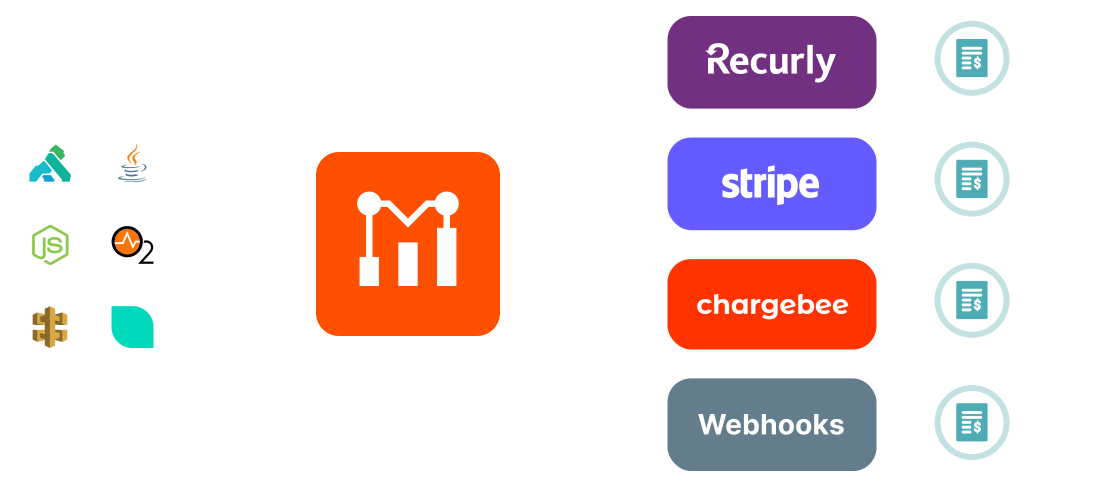
Usage-based pricing on capability events. Once capabilities are first-class, usage-based pricing becomes a configuration exercise instead of an engineering project. Moesif’s Billing Meters watch capability-level events (not raw API calls) and roll them into Stripe or another billing system. When your AI customer asks “why was my bill $4,200 last month?”, “you made 4.2M tool calls” is a worse answer than “your agent invoked the Extract Entities capability 1.8M times and Generate Embedding 2.4M times.”
Internal chargeback. The same instrumentation powers internal cost attribution. A platform team can publish an internal chargeback model where each downstream team is billed for the capabilities it consumes, sharpening incentives in a way flat infrastructure budgets don’t.
Pricing bundles, not endpoints. When packaging a tier, the question shifts from “how many API calls?” to “which capabilities are in this tier, and what’s the included usage?” Growth includes Process Refund up to 10K/month; Enterprise includes it unlimited plus Multi-Currency Refund. That’s a bundle sales can sell and procurement can understand.
Governance, Observability, and Capability Maturity
Capabilities only deliver on the promise if you can see them in production. Most platform teams that adopt capability thinking trip on the same step: they design the capability catalog, then never wire it to the actual traffic, so the catalog rots while the API keeps shipping.
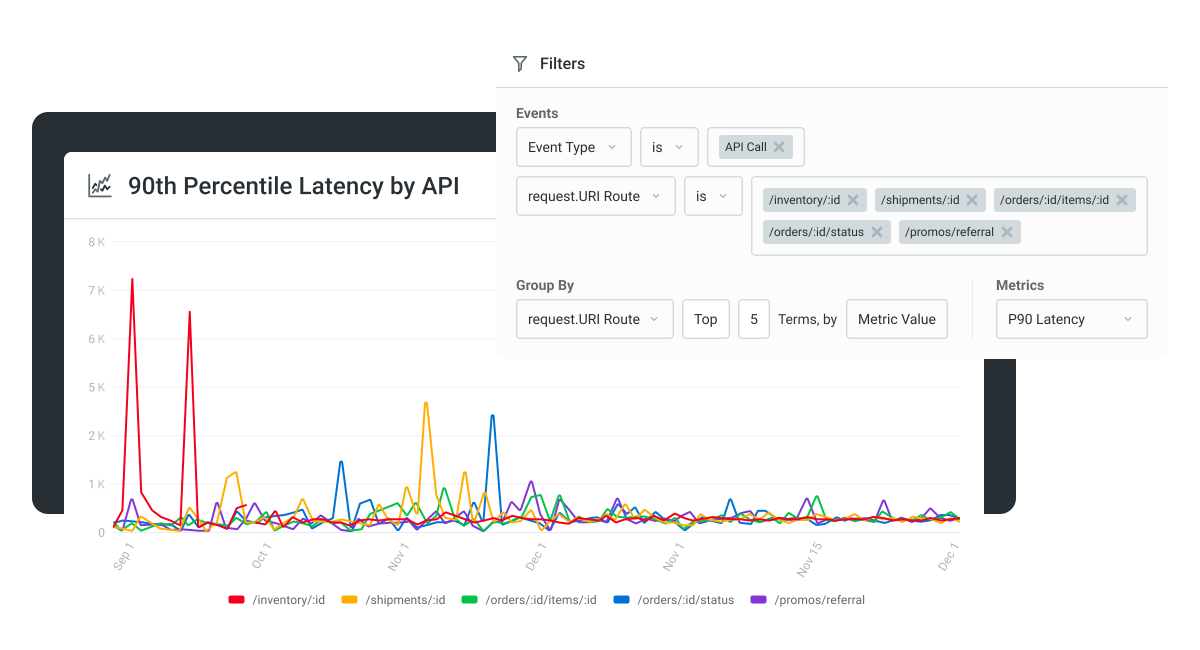
Capability-level analytics. Knowing that POST /v3/charges/{id}/refunds was called 12,400 times tells you very little. Knowing that Process Refund ran 12,400 times, that 90% of invocations came from three accounts, that Acme is on the Growth tier consuming at 4x its included rate, and that p95 latency spiked 280ms after last week’s deploy tells you everything. The API metrics that matter for platform teams are nearly all capability-level, not endpoint-level. This is the layer we sit at: capability-level analytics attributed to specific accounts, feeding both product (for prioritization) and billing (for monetization).
Shadow capabilities. Every long-lived API accumulates capabilities nobody put in the catalog. The legacy /v1/legacy/refund one customer still hits. The internal admin endpoint that quietly got exposed to a partner. The undocumented header that changes behavior. Capability-level observability surfaces these by diffing the declared catalog against actual traffic; anything called in production but missing from the catalog is a shadow capability to document, deprecate, or block.
Lifecycle and maturity. Each capability moves through experimental, beta, GA, deprecated, retired. Transitions should be visible in the catalog and enforced in governance. An experimental capability shouldn’t be allowed in a sales contract; a deprecated capability should generate warnings (eventually hard failures) when consumers call it. Tying this to consumption data lets you measure deprecation: “Process Refund v1 is deprecated, 84% of traffic has migrated to v2, three customers account for the remaining 16%.”
Maturity models. A rough four-stage view: Level 1 platforms expose endpoints with no capability layer. Level 2 have a catalog but no runtime enforcement. Level 3 instrument capability-level events and use them for analytics and monetization. Level 4 govern access, billing, and lifecycle at the capability layer end-to-end and expose metadata to AI agents through MCP. Most enterprise platforms today sit at Level 1 or 2.
How to Build a Capability-First API Strategy
Adopting capability thinking on a greenfield API is straightforward. Retrofitting it on a platform with three years of accumulated endpoints is the harder problem. Here’s a sequence that works.
1. Map existing endpoints to business capabilities. Take the OpenAPI spec, sit a PM next to an engineer, and for each operation ask: “What’s the business outcome this delivers?” Most teams find 80% of their endpoints collapse into 30-40 capabilities. The remaining 20% reveal either real capabilities that were never named or endpoints that could be deprecated.
2. Define capabilities in business language. Write the catalog in the language a customer would use. “Process Refund,” not “RefundService.execute.” This is the artifact sales, docs, and AI agent integrations all read.
3. Build the catalog. OpenAPI tags + extensions work fine at small scale; Backstage, port.io, or internal builds make sense larger. The catalog should answer for any capability: who owns it, lifecycle stage, SLO, runbook, which endpoints implement it, what it’s metered as.
4. Instrument every capability call. Every invocation should produce a structured event with capability name, consumer identity, input shape, result, and latency. This is the foundation of capability-level analytics and AI-driven API strategy. Without it, the catalog is a wiki page.
5. Iterate from data. The catalog you write on day one will be wrong. Capabilities you thought were core will turn out barely used; capabilities you missed will drive most of the value. Usage data tells you what to invest in, deprecate, bundle, and price separately.
Order matters. Teams that build the catalog without instrumenting fall into theater. Teams that instrument without a catalog drown in raw event data.
API Capabilities FAQ
What is the difference between an API and an API capability?
An API is the technical interface: a set of endpoints, schemas, and protocols a consumer uses to interact with a system. An API capability is a discrete business function that the API exposes: “Process Refund,” “Cancel Subscription,” “Summarize Document.” One API typically exposes many capabilities, and a single capability can be exposed through more than one API surface (REST, GraphQL, MCP).
What are the 4 types of API?
The most common taxonomy is by audience: public (or open) APIs available to any developer; partner APIs available under contract to specific business partners; private (or internal) APIs available only inside an organization; and composite APIs that bundle calls to other APIs into a higher-level operation. Capabilities are orthogonal to this: any of the four types can expose any of the capability flavors described above.
What is API capability in cloud computing?
In cloud platforms, “API capability” refers to a specific function the cloud service exposes. AWS, Azure, and GCP all describe their services in capability terms (“Run a query,” “Train a model,” “Provision a database”) even though the underlying APIs are larger and more granular. Cloud SDKs typically wrap the raw API into capability-named methods for the same reason: developers think in capabilities, not endpoints.
How do AI agents use API capabilities?
Agents discover capabilities through machine-readable manifests (OpenAPI documents, MCP tools/list responses) and decide which to invoke based on metadata: name, description, input schema, and tags. The cleaner the metadata, the better agents perform. An API exposing 200 thinly described endpoints is harder for an agent to use than one exposing 40 well-named capabilities, even with identical underlying functionality.
The shift from endpoints to capabilities is, ultimately, about treating your API as a product instead of an implementation detail. The teams that get this right build catalogs, instrument capability-level events, and let consumption data drive pricing, packaging, and governance. The teams that don’t end up debugging billing disputes and trying to retrofit observability into platforms that were never designed to be observed.
If you want to see what capability-level analytics look like in practice, our API observability tooling is built around this model: every capability invocation, attributed to a consumer, with the data feeding both product analytics and usage-based billing. Worth a look if you’re moving past endpoint-level thinking.

Related Articles

API Strategy
Leveraging AI For a Better API Strategy
Learn how to leverage AI to build and fortify your API strategy. Improve design, governance, documentation, and align APIs with business outcomes.
API Strategy
The 5 Best Mixpanel Alternatives of 2025
Learn about the best Mixpanel alternatives to determine the right analytics solution for your use case.

API Development
How to Leverage Moesif Effectively for API Observability
Effectively leverage Moesif for API observability through best practices for integration, event enrichment, custom actions, and engineering workflow integrat...
API Strategy
How to Build an Internal Chargeback Model for Your API and AI Usage Using Moesif
Use Moesif to implement internal chargebacks and enable precise API and AI cost attribution for better transparency and resource optimization.