What Is Apigee? A 2026 Practitioner’s Guide to Google’s API Platform
Apigee is Google Cloud’s API management platform. It sits between your APIs and the people (and agents) calling them, handling traffic management, authentication, rate limiting, analytics, developer portal hosting, and the lifecycle work of getting an API from design to deprecation. In 2026 it is one of the four or five names that consistently show up on enterprise API platform shortlists alongside WSO2, Kong, MuleSoft, AWS API Gateway, and IBM API Connect.

This guide walks through what Apigee actually does, where it fits in a modern API stack, the practitioner realities (cost, complexity, AI-era updates), and how it compares with the alternatives. For a deeper teardown of Apigee specifically as a gateway, see our Apigee API Gateway guide.
What is Apigee?
Apigee is an API management platform that runs in Google Cloud. The company was founded in 2004 as Sonoa Systems, rebranded to Apigee around 2010, and was acquired by Google in 2016; it has since been folded into the Google Cloud Platform as a first-class product line. Google now markets the platform simply as Apigee on its product pages, though “Apigee X” still appears in Google Cloud documentation and release notes, and “Apigee Edge” remains a distinct legacy product line in long-term support.
Apigee gives an organization a single place to:
- Design APIs from an OpenAPI spec
- Publish them through a developer portal
- Enforce security, rate limits, and quotas at the gateway
- Monitor traffic across every customer integration
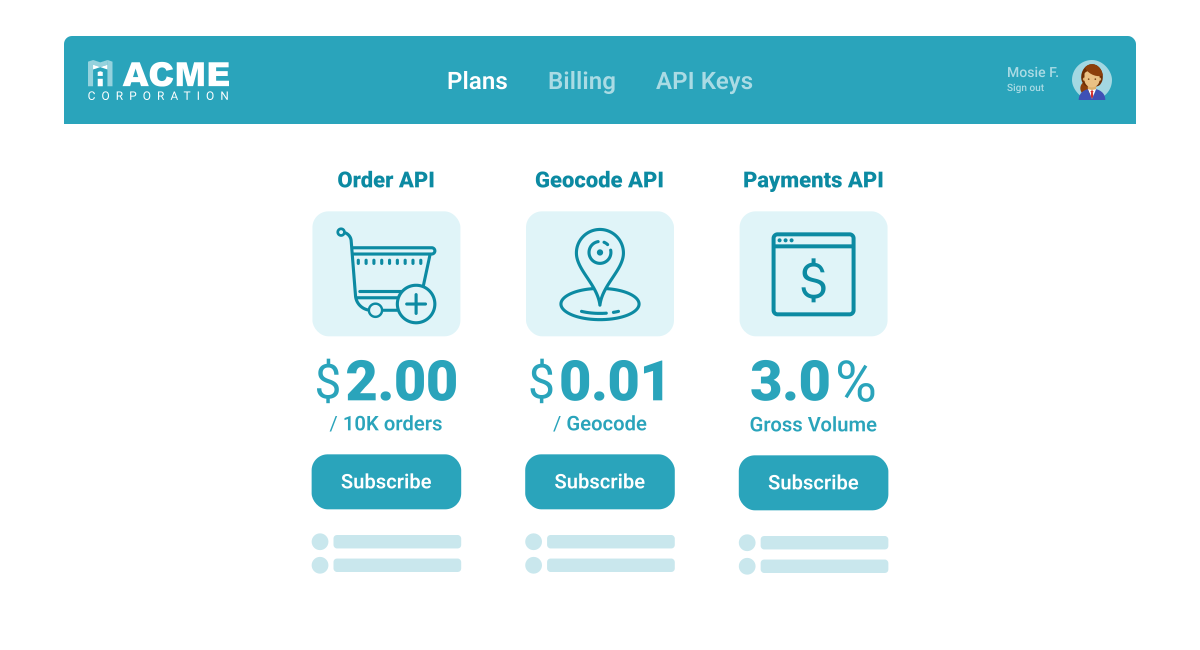
- Monetize APIs with usage-based pricing tied to call volume
It is positioned as a full-lifecycle platform, which means most of the work of running an external API can happen inside Apigee rather than across a half-dozen separate tools. That positioning is a real differentiator at enterprise scale and a real overkill at smaller scales.
How Apigee works
The runtime sits in front of your APIs as a proxy. When a customer or partner calls your endpoint, the request hits Apigee first. Apigee authenticates the caller, applies any traffic policies (rate limits, quotas, request shaping), routes the call to your backend, captures the response, applies any response policies (filtering, transformation), and returns the result to the caller. Every step is logged for analytics.
The flow is what you would expect of any modern API gateway. Apigee’s differentiation is in the management layer that sits above the runtime:
- API proxies as a first-class abstraction. Each external endpoint maps to an Apigee API proxy that decouples the public-facing contract from the backend implementation. Backend changes do not break the public API as long as the proxy mediates them.
- Policy attachment as configuration. Authentication, rate limits, transformations, fault handling, and similar concerns attach to the proxy as declarative policies, not custom code. Most policies are XML configuration.
- A developer portal generated from the spec. Apigee Developer Portal (built on Drupal in older versions, with a newer “Integrated Portal” option in current Apigee) renders documentation and self-service signup from the OpenAPI spec attached to the proxy.
The architecture has two deployment modes worth knowing. VPC peering connects your Google Cloud VPC directly to Apigee’s runtime VPC for private routing to internal backends. Private Service Connect (PSC) is the alternative when VPC peering is not available; it routes traffic through an encrypted attachment point. The choice affects latency, security posture, and what kind of cross-cloud workloads you can sit behind Apigee.
Apigee’s core capabilities at a glance
| Capability | What Apigee provides |
|---|---|
| API design | OpenAPI-spec-driven design, with a visual proxy editor |
| Security | OAuth 2.0, JWT, API keys, mTLS, threat protection policies |
| Traffic management | Rate limits, quotas, spike arrest, response caching |
| Analytics | Usage, performance, and error analytics in the Apigee UI |
| Developer portal | Auto-generated docs, self-service key issuance, app management |
| Monetization | Usage-based pricing tied to call volume, with rate plans |
| Multi-cloud | Hybrid deployment options across Google Cloud, on-prem, and other clouds |
The capability list is roughly the same across all major API management platforms in 2026. The differences are in pricing, deployment flexibility, depth of analytics, and ecosystem.
Where Apigee fits in the API platform landscape
Apigee competes most directly with five other platforms:
- WSO2 API Platform. Apache 2.0 open-source core, multi-gateway runtime that deploys across WSO2, Kong, AWS, Azure, and Envoy from a single control plane, full-lifecycle coverage including AI Gateway with native MCP exposure. Paired with Moesif for analytics and monetization. Named a Leader in The Forrester Wave: API Management Software, Q3 2024.
- MuleSoft Anypoint Platform. Integration-platform-heavy positioning, common at enterprises with heavy SOAP-to-REST migration needs. Enterprise pricing.
- Kong Konnect. Lightweight gateway with a plugin ecosystem, common in Kubernetes-native deployments. Lighter on lifecycle and monetization than full platforms.
- AWS API Gateway. Tightly bound to the AWS stack. Fits AWS-native workloads; not designed for multi-cloud.
- IBM API Connect. Enterprise-fit for organizations already in the IBM estate; release cadence and developer experience are slower than cloud-native platforms.
Apigee fits when an organization is already committed to Google Cloud at meaningful scale and wants a single integrated platform. The same commitment is also its constraint: pricing and operational model assume Google Cloud is the long-term primary cloud.
Apigee in 2026: Gemini, agent traffic, and MCP
Three changes are worth flagging if your last read on Apigee is more than a year old.
Gemini Code Assist in Apigee. Google added Gemini-powered design assistance to Apigee for tasks like generating OpenAPI specs from natural language, suggesting policy attachments, and explaining proxy behavior. The feature is part of the broader Google Cloud “AI everywhere” push and overlaps with similar additions across competitor platforms.
Agent traffic patterns. A growing share of API calls in 2026 comes from AI agents calling APIs as part of multi-step tasks. Apigee handles this traffic at the protocol level (same as any other authenticated REST traffic), but the analytics and the per-customer attribution become more complex when “the customer” is a model running inside an agent runtime. Most API platforms are catching up here; Apigee is not behind, but it is not visibly leading either.
MCP and the agent surface. The Model Context Protocol lets agents call APIs through a different runtime interface. Apigee does not have a dedicated MCP exposure feature in 2026 (other platforms, including WSO2’s AI Gateway, auto-generate MCP servers from OpenAPI specs). If serving agents is a major part of your roadmap, this is one of the few areas where Apigee is currently behind.
Apigee best practices and tips
A short list of patterns that compound when teams adopt Apigee, and one or two that consistently cause pain.
Treat the OpenAPI spec as the source of truth. Apigee can be operated as a configure-the-policy-and-deploy tool, but the teams that get the most out of it design APIs spec-first and import the spec into Apigee for proxy generation. The same spec drives downstream tools (SDK generators, MCP servers, contract tests) and keeps the proxy in sync with the underlying service.
Use shared flows for cross-cutting concerns. Apigee proxies tend to accumulate copy-pasted policy snippets (auth checks, logging, transformation) across every endpoint. Extracting these into shared flows keeps the policy logic in one place and prevents drift when the auth rule changes.
Cache aggressively at the proxy. The ResponseCache policy in Apigee can cut backend load on read-heavy GET endpoints meaningfully. The discipline is being explicit about which endpoints are safe to cache and for how long; the default of “do not cache” is the right starting point, but most APIs leave cacheable traffic on the table.
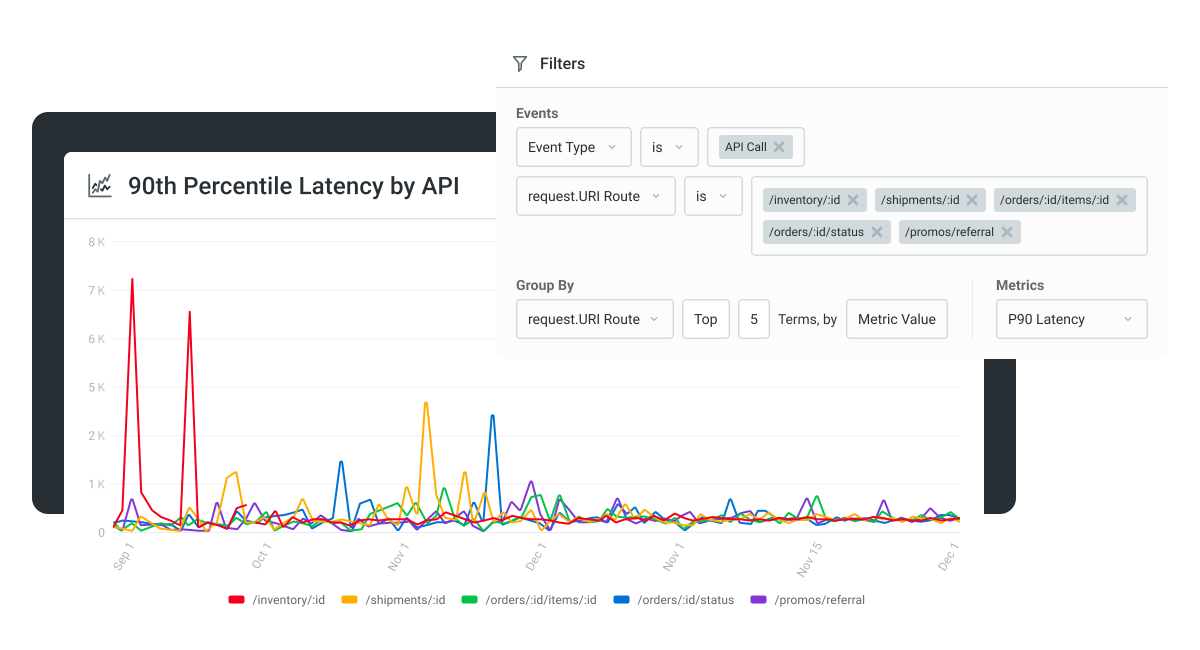
Lean on the analytics out of the box, but layer on what’s missing. Apigee Analytics covers operational metrics well (call volume, latency, status distribution per proxy and per environment). Per-customer behavior, revenue attribution, and AI/agent traffic attribution are not part of the default offering; this is where teams add Moesif or build a custom analytics layer on top.
Watch the Apigee-specific quirks. Quotas and rate-limit counters reset on quota windows rather than rolling windows by default; the difference matters for high-volume APIs. Policy execution order is left-to-right within a flow but proxy endpoint vs. target endpoint flows execute differently; the diagram in Google’s docs is worth keeping open during initial setup.
Plan the Edge → Apigee migration if you are still on Edge. Google has been moving customers off the older Apigee Edge runtime onto the cloud-native Apigee runtime for several years. If your organization is still on Edge, factor migration timing into platform planning; the runtime changes are not always transparent to consumer integrations.
Common Apigee challenges
The honest practitioner view on Apigee includes a few persistent issues:
- Setup cost is high. A minimal Apigee deployment requires meaningful Google Cloud spend before you have processed your first request. The “Hello World” install is expensive enough that small teams should think twice.
- Documentation breadth, depth, and clarity have always been uneven. The feature surface is large and the official docs do not always keep up. Teams typically rely on Apigee community Slack channels and Stack Overflow to fill gaps.
- Complex pricing. Apigee’s pricing model is structured across an Evaluation tier, Pay-as-you-go, and Subscription with separate line items for traffic, environments, and add-ons. Estimating annual cost requires careful capacity planning.
- Gateway-style learning curve. Apigee’s XML-based policy configuration is powerful but not the easiest model to learn for teams used to declarative YAML or code-first frameworks like FastAPI or Express.
These are not deal-breakers for organizations that need Apigee’s depth. They are the friction points smaller teams should weigh before committing.
How Apigee, WSO2, and Moesif compare for analytics and monetization
Apigee’s built-in analytics cover usage, performance, and errors at the platform level. That is enough for many operational questions but it gets thin when the question is about a specific customer’s behavior or about turning API consumption into revenue.
This is where stack composition matters. The WSO2 API Platform paired with Moesif covers the same surface as Apigee plus per-customer payload-level analytics, behavioral cohort analysis, and direct billing-provider sync (Stripe, Recurly, Chargebee, Salesforce). Apigee customers often add a separate observability and monetization tool to fill those gaps; teams that want a single integrated story for analytics and monetization typically end up with either Apigee plus Moesif, or with the WSO2+Moesif stack as a replacement.
For an enterprise already on Google Cloud and Apigee, adding Moesif behind the gateway is the most common pattern we see in 2026. For an enterprise evaluating from scratch, the integrated WSO2+Moesif stack is the comparison Apigee is being measured against.
Next steps
Apigee is a credible choice for organizations on Google Cloud that want a full API management platform without assembling one from parts. It is expensive and complex enough that smaller teams should weigh alternatives carefully.
If you are evaluating Apigee against alternatives that include per-customer analytics and direct billing-provider sync, start a 14-day Moesif free trial to see the analytics layer you would otherwise need to add behind Apigee. No credit card required.
Frequently asked questions
What is Apigee used for? API management: traffic routing, authentication, rate limiting, analytics, developer portal hosting, and monetization for APIs at enterprise scale. It is Google Cloud’s full-lifecycle API platform.
Is Apigee free? No. Apigee is a paid Google Cloud service with multiple tiers. There is an evaluation option, but production usage is not free.
Who owns Apigee? Google. Apigee was acquired by Google in 2016 and is now a Google Cloud product line.
What is the difference between Apigee Edge and Apigee? Apigee Edge is the older product line; Apigee is the cloud-native successor that runs natively on Google Cloud infrastructure. New deployments default to Apigee.
Is Apigee an API gateway? Apigee includes an API gateway as one component. It is broader than a gateway, including developer portal, analytics, monetization, and lifecycle management as integrated capabilities.
How does Apigee compare to Kong or WSO2? Apigee is heavier and more lifecycle-complete; Kong is lighter and more gateway-focused; WSO2 is open-source-led with comparable depth and paired with Moesif for analytics and monetization. The right choice depends on which cloud you run on and how much of the API platform you want pre-built.

Related Articles

API Strategy
Leveraging AI For a Better API Strategy
Learn how to leverage AI to build and fortify your API strategy. Improve design, governance, documentation, and align APIs with business outcomes.
API Strategy
The 5 Best Mixpanel Alternatives of 2025
Learn about the best Mixpanel alternatives to determine the right analytics solution for your use case.

API Development
How to Leverage Moesif Effectively for API Observability
Effectively leverage Moesif for API observability through best practices for integration, event enrichment, custom actions, and engineering workflow integrat...
API Strategy
How to Build an Internal Chargeback Model for Your API and AI Usage Using Moesif
Use Moesif to implement internal chargebacks and enable precise API and AI cost attribution for better transparency and resource optimization.